SCH4U - Chemistry 12 (2024-25) - A
SCH4U-25A
1-1A: Rounding & Significant Digits
Description
In this review you will learn how to properly round values and maintain the appropriate number of significant digits throughout your calculations.
Page content
Significant Digits & Scientific Notation Review
In the study of motion there are several steps involved to help us understand and analyze our observations. Part of this process involves collecting data and then calculating values based on our observations. When performing these tasks it is important that we remain consistent in how we report the information we are recording and how we treat the values that we are calculating. This means that we need to following the rules of rounding and significant digits when solving problems. In this review you will learn how to properly round values and maintain the appropriate number of significant digits throughout your calculations.
Significant Figures Review
Numerical values given in problems are expressed using a certain number of digits. This number of digits should be linked to the accuracy with which the number was measured. For instance, if you're using a ruler whose smallest marking is a centimeter, you cannot accurately express quantities in millimeters or smaller. As a result, you could measure your height and say that you were 163 cm tall or 1.63 m, but to state your height as 163.4 cm or 1.634 m would indicate more accuracy than you had at your disposal because you are including millimeters in your reporting of the value.
Determining the Number of Significant Digits:
To determine the number of significant digits given in each quantity that you use in your calculation follow these steps:
- Count the number of digits shown before and after the decimal place.
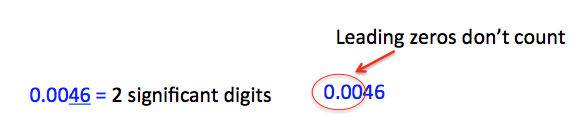
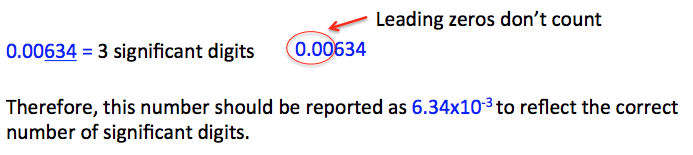
- Leading zeros don't count (e.g., 002.3 = 2 significant digits, 0.0006 = 1 significant digit).
- Any zero after the first nonzero number may count depending on the following.
- If the zeros are after the decimal place, they count towards the significant figures (e.g., 3.00 = 3 significant digits).
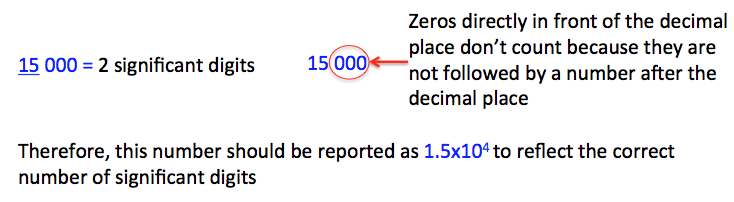
- If the zeros are directly in front of the decimal place (e.g., 1 200 = 2 significant digits ) they do not count unless they're followed by other numbers after the decimal place (e.g., 12 000.0 = 6 significant digits).
Examples:
How many significant digits in the following examples:
a) 0.0046
b) 15,000
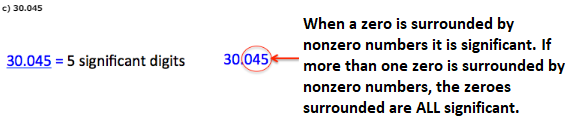
d) 0.00634
Calculations Using Significant Digits
When carrying numbers through a calculation, you must take steps to ensure that your results do not indicate a greater accuracy than you had in your given information. Note that you should keep extra digits throughout your calculations and only round to the proper number of significant digits for your final result. To do this, follow the steps below:
Addition & Subtraction
For addition and subtraction, the number of decimal places in the answer should be the same as the number of decimal places in the measurement with the fewest decimal places.
Example: 2.0056 + 4.03 = ?

Multiplication & Division
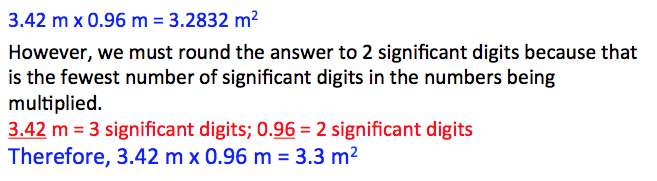
- For multiplication or division, you'll need to determine the number of significant digits in the numbers being multiplied or divided. Your answer should have the smallest number of significant digits that are present in the given information used in the calculation.
Example: 3.42 m x 0.96 m = ?
Additional Notes Regarding Significant Digits:
Note that some questions may specifically ask you to report your answer with a given number of significant digits. When this is the case you may ignore the rules of significant digits and simply follow the instructions given in the question.