SCH4U - Chemistry 12 (2024-25) - A
SCH4U-25A
1-7B: Plagiarism - What it is and how to avoid it
Description
In this activity you will learn about what plagiarism is and how you can avoid it when completing research assignments and other projects.
Page content
Plagiarism - What it is and how to avoid it
In this activity you will learn about plagiarism and how to avoid it when completing research assignments. Navigate your way carefully. If you have any questions, ask your teacher before completing the research assignment at the end of this lesson.
Plagiarism refers to the act of using someone else's work and/or ideas, and passing them off as your own, or without giving proper credit to the source.
Plagiarism is very serious, and the punishment for it can be extreme, ranging anywhere from failing your assignment, to more serious consequences (especially in post-secondary school).
There are three types of plagiarism.
Copy and Paste
Copying paragraphs, sentences, or any information from websites, articles etc. is helpful during the research stage. However, pasting this information directly into your assignment is direct plagiarism. Copy and paste should only be used for organizing your information prior to rewording it. Note: Typing those paragraphs, sentences or any information using your own keyboard in NO different than using the Copy and Paste tools.
Example: Assume you were writing a short paper on plagiarism and wanted to use information from this website. You decide to copy and paste what's inside the box:
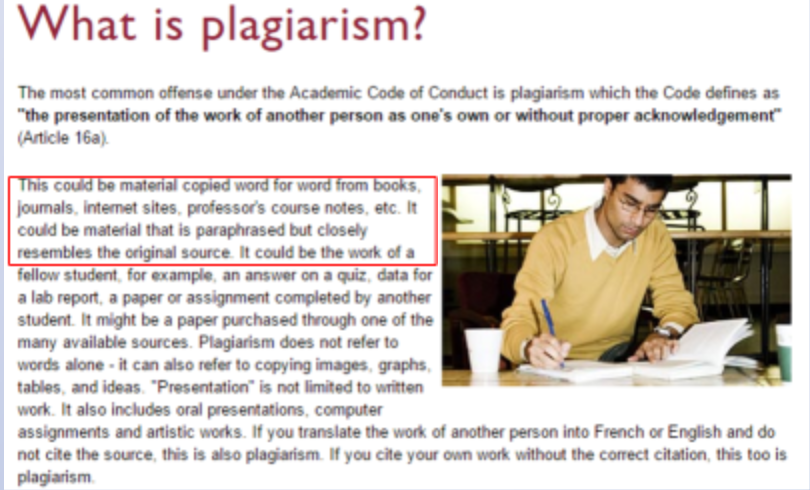
Plagiarism is a widespread problem in the world today, largely due to the abundance of information on the Internet. But what is plagiarism? This could be material copied word for word from books, journals, internet sites, professor's course notes, etc. It could be material that is paraphrased but closely resembles the original source. It is necessary that teachers begin teaching students about these concepts at an early age to prevent plagiarism in the future.
Explanation: The information in red was directly pasted into the summary paper, meaning that I stole the author's information, and didn't give them credit. Typing the exact information yourself still qualifies as direct copying and is plagiarism. This information should either be quoted and cited, or it should be reworded, then cited.
Direct Quotes
Putting quotation marks around words does not credit the source of information, nor does it protect you from plagiarism. You must state WHO you are quoting, whether it is a person, a website, a book, etc. If you do not credit the quote to anyone or anything, then it is as if you simply made the information up and attempted to quote it as fact. This not only makes your evidence weak and unreliable, but it is plagiarism!
Example: Let's use the example from the Copy and Paste section, but rather than copy and paste it into our writeup, we will quote it.
Plagiarism is a widespread problem in the world today, largely due to the abundance of information on the Internet. But what is plagiarism? "This could be material copied word for word from books, journals, internet sites, professor's course notes, etc. It could be material that is paraphrased but closely resembles the original source." It is necessary that teachers begin teaching students about these concepts at an early age to prevent plagiarism in the future.
Explanation: What is the difference between copy paste and direct quotes? The only difference is the quotation marks. But what effect do these quotation marks have on the credibility of the sentence? None. Without crediting the quote to it's rightful author, the information is as much plagiarism as the original copy and paste.
Paraphrasing
Paraphrasing is often seen as a way to avoid having to cite sources, and many believe that it does not fall under plagiarism. However, if it is information that you attained from an outside source (books, website, newspaper, etc.) than it must be cited. This includes things people say to you in conversations. If you get an idea from a friend, family member, teacher, etc. and they give you an idea that you use in your paper, then you need to credit them! You can cite it as an interview or a simple citation. Paraphrasing the language and sentence structure is useful for making the information flow more smoothly, and follow your style of writing. However, you must credit the proper sources, as it is their ideas that you are rewording.
Example: Let's use the example from the Copy and Paste section and see what it looks like if we paraphrased the information.
Plagiarism is a widespread problem in the world today, largely due to the abundance of information on the Internet. But what is plagiarism? Plagiarism can be any information copied from different sources, such as books, journals, websites, professor's notes, etc. It can also be information that is paraphrased but still resembles the ideas within the original source. It is necessary that teachers begin teaching students about these concepts at an early age to prevent plagiarism in the future.
Explanation: What is the difference between copy paste and paraphrasing? While the content in red is different, the information is all based on the ideas from the same website. This means that although the information was note copied word for word, the website still needs to be credited for providing you with those ideas and facts. If it was your own idea, you wouldn't have had to use the website to begin with!
You now know not to copy, quote or paraphrase information in any way without crediting the author or the source of that information.