SCH4U - Chemistry 12 (2024-25) - A
SCH4U-25A
1-7D: Research Skills - Finding Credible Sources
Description
In this activity you will navigate your way through an interactive presentation as you learn how to determine the credibility of sources during your research.
Page content
Research Skills - Finding Credible Sources
In this activity you will navigate your way through an interactive presentation as you learn how to determine the credibility of sources during your research. If you have any questions, ask your teacher before completing the research assignment at the end of this lesson.
Judging Credible Sources
The internet is filled with useful information to be used in your writing, but it is also a place for everyday people to write and publish anything they please. You have to be careful when researching in order to avoid the inaccurate, biased information that will hurt your writing rather than help it. To make sure the pages you are on are credible, you need to see if they meet the criteria of our five characteristics: Validity, Relevance, Content, Purpose, and Accuracy.
Validity
- Who is the author(s) of the site?
- Are they a reliable author?
- Does the website have an author at all? If not, is the website itself reliable?
- Look for a reliable institution. What is the first part (major domain) of the web address (URL)?
- This indicates the site's origin:
- .com = commercial
- .com websites are the most common domain,
- Blogs, message boards, or any sources where anyone can the author should be taken lightly.
- Authors on these platforms often include personal bias or opinions.
- The websites themselves may be running for purposes other than providing valuable information.
- It is important to look for the author and their credentials. When unsure, save the URL and look for another source to back up that one!
- .edu = educational
- .edu websites are run by educational institutions, and contain trustworthy information from valid sources.
- They often have follow-up links for further reading, or a list of the sources they used. These websites are often a good choice.
- Be cautious of any bias within these sources to make sure they are teaching your objectively.
- .org = non-profit organization
- .org websites are a good source of statistics and facts related to issues that their organizations fight for/against
- They have lots of information related to their initiatives, or related to initiatives they are fighting to stop.
- However, these sources need to be read more carefully, as these organizations will be biased towards their own side, and are always trying to promote their cause!
- .gov = government
- .gov websites are government-run
- Useful for providing information on statistics, laws and legislation from that country
- Lots of bias within these sites regarding government-run corporations, and any initiatives or programs they are involved in
- For example, if you are reading up on government contributions to third world countries (such as the World Bank), it would be wise to compare their information with that of non-profit organizations who oppose them
- .com = commercial
Relevance
- When was the site first created?
- Websites that were created recently may not be trustworthy and will require extra sources to back up the information.
- When was the site last updated?
- Websites that have been around a long time but are not updated can lead to information that is outdated and no longer relevant or accurate. These sources should be backed up by another source.
Content
- What is the level of information on the website? Be cautious of too little.
- Are there links to other useful and reliable sites?
- How is the site set up? Functions such as an in-site index/table or contents, as well as it's own search bar should assist with navigating through the information.
- Does the advertising overpower the content? It shouldn't.
Purpose
- Many websites may seem valid, but keep an eye out for any possible biases or hidden motives they might have.
- Think about the reason for the creation of the website, what is their goal or mission? Is this site trying to persuade you? Educate you? Promote their cause? Market a product? Make a profit?
- Are there any biases that might be promoted: racial, gender, religious, social, or other types? Even non-profit .org sites can be biased towards certain issues.
Accuracy
- How can you be sure that the information is accurate?
- Is the author an expert in the field? Why should we believe them? Where did they get their information from?
- Look for references, footnotes, endnotes, etc.
- Always verify your information with secondary sources, especially when using resources where anyone can be the author.
Let's look at an example!
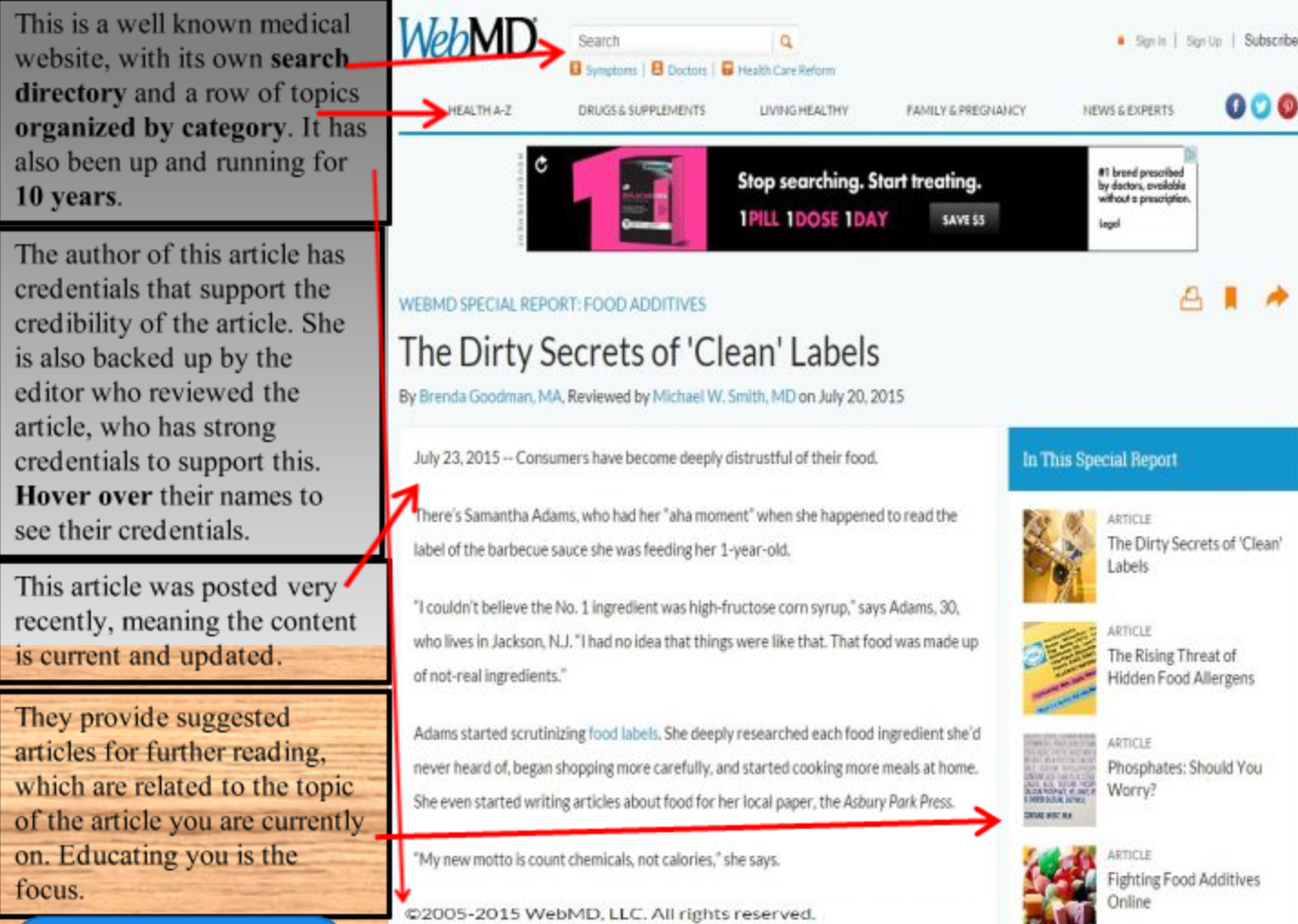
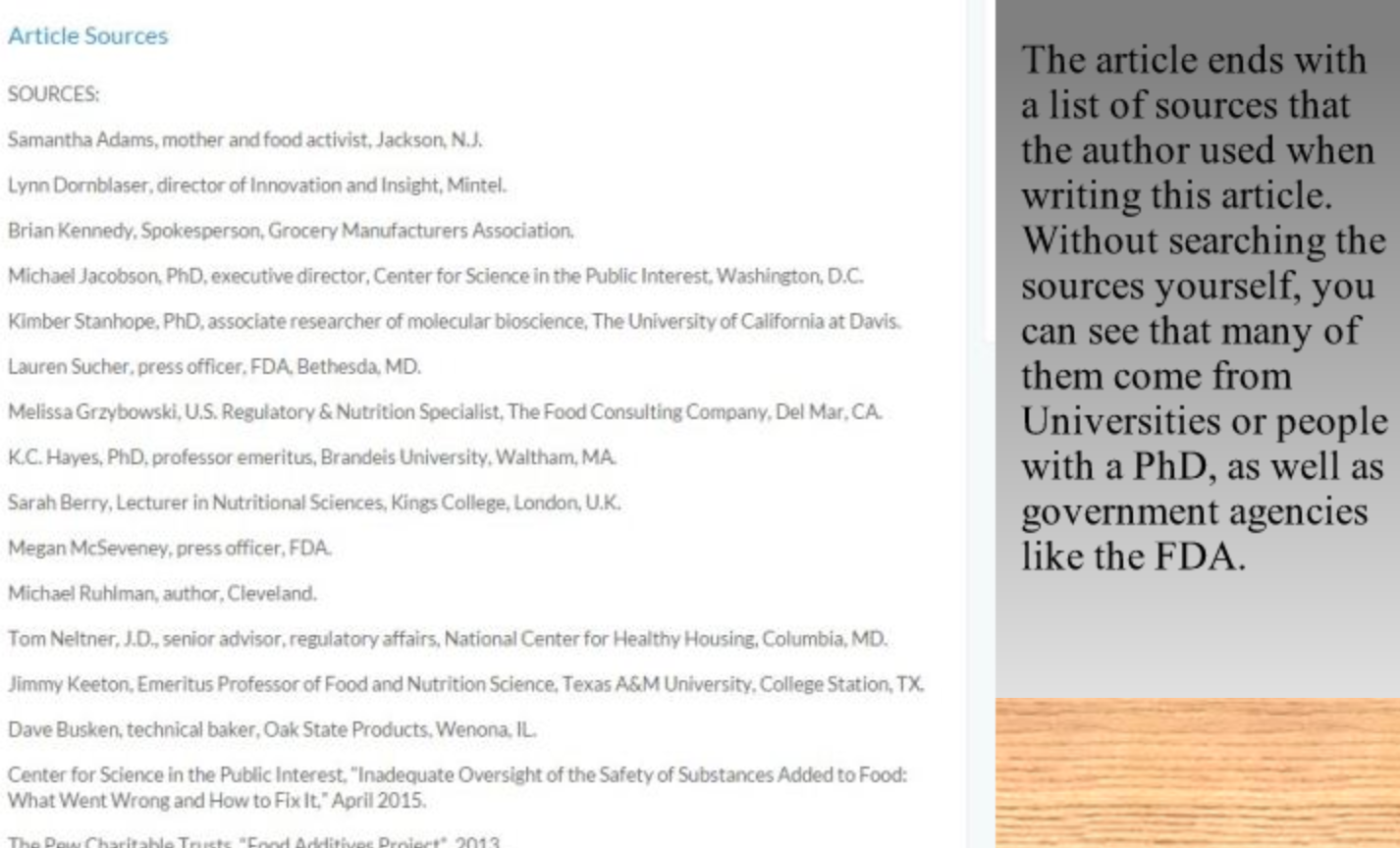
It's important to remember that your sources don't need to fulfill all five of the characteristics we have discussed. Website or articles can still be deemed credible when only fulfill a few parts of the criteria, as long as you can reasonably judge that
they are credible. If you're unsure if your source is credible due to a mixture of good and bad signs, find another source to back up the information.
Tips for finding credible sources!
- A great way to find credible information without using your search engine is to use a Database.
- Databases are online collections of information. All information that is judged as credible and falls within the field or subject of that database is added to it.
- All information off of databases are credible, however, some bias still exists, which you need to look out for within the author's writing, while also taking into account the year it was published (relating to relevance).
- These databases contain peer-reviewed journals and books, scholarly articles, periodicals, essay, etc. which are written by experts.
- Databases can be accessed through your home computer, school, or library.
Summing Up
- Go into each website with an open mind, don't assume that the information will be credible, but don't assume that the information will be fake either!
- Scholarly journals, books, reviewed articles, educational websites, and online databases are all great sources of credible information.
- Use those above sources and back them up with your web searches to create the ultimate argument for your assignment.