SCH4U - Chemistry 12 (2024-25) - A
SCH4U-25A
1-7E: Citation - How to Credit Sources of Research
Description
In this activity you will navigate your way through an interactive presentation as you learn how to properly credit sources of research used when completing research assignments.
Page content
Citation - How to Credit Sources of Research
In this activity you will navigate your way through an interactive presentation as you learn how to properly credit sources of research used when completing research assignments. If you have any questions, ask your teacher before completing the research assignment at the end of this lesson.
What is citing?
- Citing is the process of giving credit to the rightful authors, websites, or businesses for the information you used in your writing which was taken from them.
- It is an acknowledgement that you used that source to obtain information used in a sentence or paragraph, or an acknowledgement that you based your sentence or paragraph off of that source's information
When we need to cite
- Whenever you are quoting information directly from a book, article, website, etc.
- When you are paraphrasing information found within a book, article, website, etc.
- Anytime that you are using information that is gathered from another source, and is NOT common knowledge (the sky is blue, the grass is green, etc.) you need to cite it.
Why we have to cite
- Information from various sources is THEIR property, even after they publish it online.
- Using their info without giving them credit for it is theft, or plagiarism
- Choosing not to cite can lead to getting a zero on your assignment, or even more serious consequences.
Why we want to cite
- Citing can strengthen your evidence or information.
- Without citing your source, it is as if you thought of the information yourself or made it up. This weakens your evidence.
- By citing your sources, you are showing that your evidence is backed up experts and credible sources.
Example
- Imagine you are writing an essay on Medieval Times, and you begin researching information on your topic.
- You've found very reliable sources, written by expert historians, so you finish writing your essay, but choose not to cite your sources before you hand it in.
- Assuming your lack of citing would not result in you failing the paper, you get your grade back it isn't as good as you thought.
- How can this be? Your information was based on expert sources?
- Before you confront your teacher about your mark, here are some questions your teacher will be thinking about.
- "How do I know you weren't just making all of this information up?"
- "Where did you get all of this information from? I don't see any sources."
- "Why should I believe evidence written by you? Are you a historian or expert on Medieval Times? Were you there yourself?"
- When you're providing evidence, it has to come from a credible source, not only so you know your evidence is strong and credible, but so your teacher knows.
- It is a lot more convincing to see quotes from a historian who specialized in Medieval Times, that seeing paraphrased words come from a teenage student who knew little about it prior to their research. You can't argue with experts.
Citing Formats
- There are different formats for citing your sources. The main ones include: MLA, APA and Chicago.
- This lesson will be a more general guideline for citing, but for extra help on understanding what each of these formats require, you can check out. https://owl.english.purdue.edu/owl/section/2 or search for citation guides with your search engine.
Types of Citing
- The first lesson is to learn how to properly create a bibliography. This is much more than simply copy and pasting the URL's of the websites you visited.
- The other three type of citations you will learn about relate to citing throughout your paper at the time you used a source's information.
- Note - when doing in-text citing, footnotes, or endnotes, you still have to create a bibliography at the end!
Bibliography
- The Bibliography (or Works Cited) is the last page of any paper, and contains all relevant information related to your sources.
- The title should be centered, without any formatting (italics, underline, bold, etc)
- Entries should be sorted alphabetically by author last name
- Book, journal, and website names should italicized.
- Article titles (including articles within websites) are in quotation marks
- Put n.d. if there is no publishing date (in the spot that the publishing date would be in)
- Not all of this information will be available for all your sources, but it is important to provide as much information as possible to make it easy for your teacher to locate the source.
- Also, the more information available about a topic, the more legitimate and credible it seems.
- Different mediums require slightly different information, meaning websites will have a slightly different citing format than books or articles will.
Below is the format for citing these sources in your Bibliography. Follow the formatting EXACTLY!
Website
Editor/Author Lastname, Firstname, "Title of article." Name of company/organization affiliated with the site. Publisher, Publishing date. Medium of publication. Date of access. URL.
Book
Author Lastname, Firstname. Title of Book. City of Publication: Publisher, Year of Publication. Medium of Publication.
Article
Author Lastname, Firstname. "Title of Article." Title of Journal Volume.Issue (Year): pages. Medium of publication.
Personal Interview (you interview someone yourself):
Lastname of person you interviewed, Firstname. Personal Interview. Date of interview.
Published Interview
Lastname of person interviewed, Firstname. Title of interview. Medium of publication.
TIP: If the interview has no name, but it is found within another source, CITE THAT SOURCE, and use the descriptor Interview after the interviewee's name.
Recorded Films, Movies, or Documentary
Title of Film. Dir. Name of director. Name of distributor/publisher, Release year. Medium of publication.
Now it's your turn to try! Open up each URL below to try to find the info to cite this website on your own!
http://www.ehow.com/how_1686_make-pizza-dough.html
Solution: Marshall, Nick. "How to Make Pizza Dough." eHow. Demand Media. n.d. Web. 25 June 2015. <http://www.ehow.com/how_1686_make-pizza-dough.html>
https://books.google.ca/books?id=KrEpfDRDsFAC&printsec=frontcover&source=gbs_ge_summary_r&cad=0#v=onepage&q&f=false
Solution: James, Henry. The Ambassadors. Rockville: Serenity Publishing, 2009. eBook.
http://www.tandfonline.com/doi/full/10.1080/1406099X.2015.1022436#.VY1shvIViko
Solution: Anspal, Sten. "Gender wage gap in Estonia: a non-parametric decomposition" Baltic Journal or Economics 15.1 (2015): 1-15. Web.
In-text cite
- This is the quickest and most simple form of citing, most commonly used in MLA format.
- This type of citing involves citing the author/organization directly at the end of the sentence, quote, or paragraph in which you used their information or ideas.
- The purpose of this citation is to provide information on the author/organization so the reader can easily find the matching bibliographic entry.
- The format for this citation includes putting the author's last name and the page number in parentheses/brackets ().
- If there is no page number then simply put the author's last name, and if there is no author then simply put the first part of the matching bibliographic entry (likely the title or article name).
- The process goes:
- Quote/Information -> In-text citation -> Continue paper
Example
An expert in building houses of cards once said, "A strong base is the cornerstone to building an unbreakable house of cards" (Wilkins 54). Without a strong base, your house will always be vulnerable to falling...
Then your matching bibliographic entry will be:
Wilkins, Josh. Building the Perfect House of Cards. Toronto: Rockstar Publishing, 2010. Print.
Using the same examples from the Bibliography section, let's see what our in-text citations would look like for web, book, and article sources, along with their corresponding bibliographic entry.
REMEMBER:
- If there is no author, use the next part of the corresponding bibliographic entry, likely the title.
- If the title is very long, use a shortened version of it.
- If there is no page number, don't worry about it! Websites will never require page numbers for citations (unless it is an online article or book)
From the website, http://www.ehow.com/how_1686_make-pizza-dough.html, how would you include an in-text citation for:
"Pizza dough is a combination of flour, water, yeast and oil."
Solution: "Pizza dough is a combination of flour, water, yeast and oil." (Marshall)
From the book, https://books.google.ca/books?id=KrEpfDRDsFAC&printsec=frontcover&source=gbs_ge_summary_r&cad=0#v=onepage&q&f=false, how would you include an in-text citation for:
"Live all you can; it's a mistake not to. It doesn't so much matter what you do in particular so long as you have your life. If you haven't had that what have you had?"
Solution: "Live
all you can; it's a mistake not to. It doesn't so much matter what you
do in particular so long as you have your life. If you haven't had that
what have you had?" (James 5)
From the article, http://www.tandfonline.com/doi/full/10.1080/1406099X.2015.1022436#.VY1shvIViko, how would you include an in-text citation for:
"Estonia is the country with the highest gender wage gap in the European Union (UN)."
Solution: "Estonia is the country with the highest gender wage gap in the European Union (UN)." (Anspal 1)
Footnotes
- Common for the Chicago method of citing, footnotes require more work that in-text citations, but is the better method when you are citing sources constantly throughout your paper.
- Footnotes keep your citations neat and organized at the bottom of the page in which the sources occur.
- When using footnote, you have 3 parts:
- Superscript
- Footnote
- Corresponding Bibliographical Entry
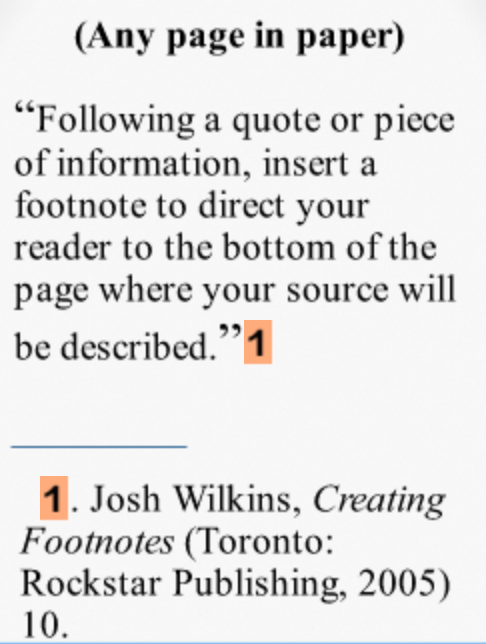
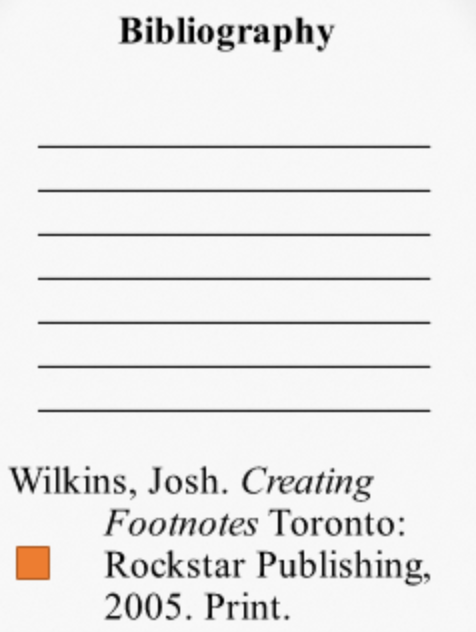
Follow the format for these sources EXACTLY as typed
Books
1. Firstname Lastname, Title of Book (Place of publication: Publisher, Year of publication), page number.
Journals
1. Firstname Lastname, "Title of Article", Title of Journal, Volume Number.Issue Number (Publishing Year): Page Number(s).
Website
1. Firstname Lastname, "Title of Web Page/Article", Name of Website/Organization, Publication Date and/or Access Date. URL.
Using the same examples from the prior sections, let's see what our footnotes would look like for web, book, and article sources, along with their corresponding bibliographic entry.
NOTE: The superscript for your footnote does not have to follow a quote, but can follow a paraphrase, summary, or any piece of information that you are crediting to that source.
http://www.ehow.com/how_1686_make-pizza-dough.html
Footnote: 1. Nick Marshall, "How to Make Pizza Dough," eHow, Accessed 25 June 2015. <http://www.ehow.com/how_1686_make-pizza-dough.html>
https://books.google.ca/books?id=KrEpfDRDsFAC&printsec=frontcover&source=gbs_ge_summary_r&cad=0#v=onepage&q&f=false
Footnote: 2. Henry James, The Ambassadors (Rockville: Serenity Publishing, 2009), 5.
http://www.tandfonline.com/doi/full/10.1080/1406099X.2015.1022436#.VY1shvIViko
Footnote: 3. Sten Anspal, "Gender Wage Gap in Estonia" Baltic Journal of Economics 15.1 (2015): 1.
Endnotes
- Endnotes are very similar to footnotes, with the only difference being the location of the note itself.
- With footnotes, the notes are put at the bottom of the same page that the superscript is on. However, with endnotes, the notes are put on their own separate page, titled 'Endnotes' (without quotes).
- The information for the endnotes are identical to footnotes, in which they follow the same process.
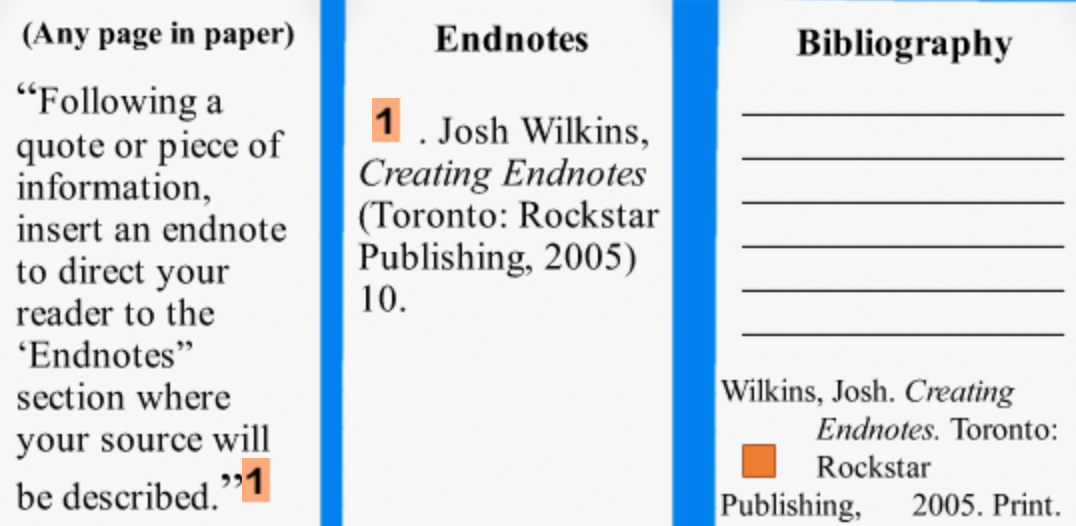
- Since the formatting and information is identical for footnotes and endnotes, you already know which format to follow! The endnotes examples would be identical to the footnotes section, except you would put the notes on the Endnotes page, on the second last page of your paper (the Bibliography is your very last page).