SCH4U - Chemistry 12 (2024-25) - A
SCH4U-25A
1-7F: Effective Communication - How to Organize and Present Information
Description
In this activity you will navigate your way through an interactive presentation as you learn how to effectively organize and present information.
Page content
Effective Communication - How to Organize and Present Information
In this activity you will learn how to effectively organize and present information. If you have any questions, ask your teacher before completing the research assignment at the end of this lesson.
Where is this useful?
- When you are writing an essay, report or any written assignment
- When you are doing verbal presentations
Why is this useful?
- To avoid having your paper/presentation come across as scattered, or having your evidence not match your arguments
- To communicate your ideas in a way that the reader or listener can easily follow along and keep track of main point you are arguing
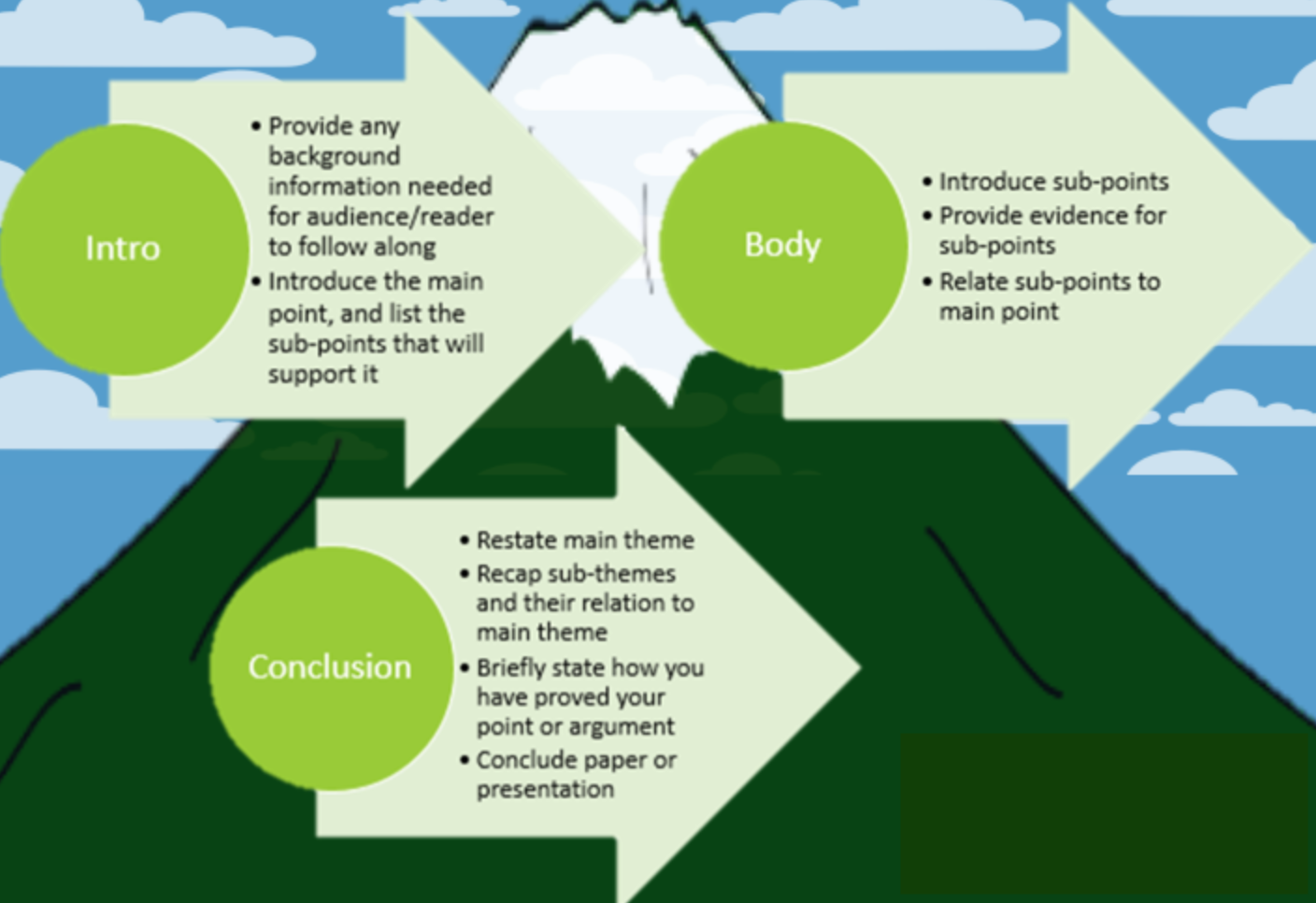
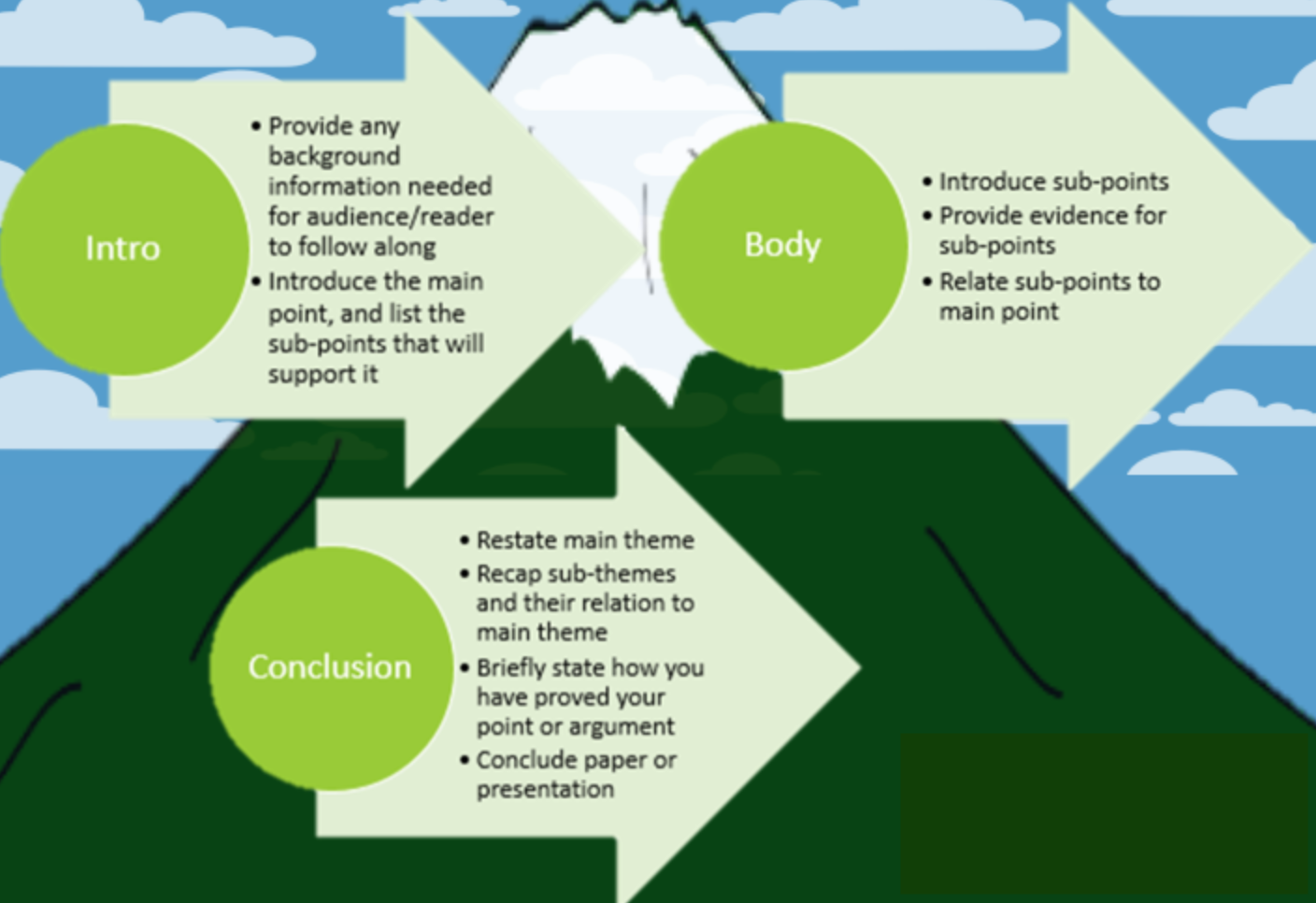
The General Format for Communicating Ideas is:
1. Introduce the topic and provide background info
2. Introduce main idea, along with supporting points
3. Discuss first point and provide supporting evidence
4. Conclude first point and transition to your next point
5. Repeat steps 3-4 until all your points are proven
6. Conclude paper/presentation by restating your points, evidence, and how they ultimately prove your main idea
After learning about each step, there will be a short example of what the step might look like if you were doing an actual assignment. These examples will be based on a hypothetical story. The plot of the story is:
Your teacher assigns a short story about a group of teenagers (Josh, Andrew, and Jennifer) who all work at a bakery together. They are always competing to see who will earn the Employee of the Month award, in which they get to take home any baked good of their choosing. The information regarding the employees' behavior throughout the month is detailed throughout the story. Your teacher tells you all to read the story, and write a short paper on which employee you believe deserves to be named Employee of the Month.
1. Introduce the topic and provide background info
- This part of the introductory paragraph helps the reader understand the overall situation.
- Never leave out important details.
- Assume the reader knows NOTHING!
- The reader should have enough background information to allow them to easily follow along.
Example: "Three teenagers: Josh, Andrew, and Jennifer are all working at a bakery together, and are pushed to work their hardest in order to win the Employee of the Month award, which comes with a prize. This prize allows the winner to take any baked good of their choosing home for their self."
2. Introduce main idea, along with supporting points
- Introduce the main argument you plan to prove.
- Introduce the supporting points that you will use to prove the main idea.
Example: "In this essay, I will argue that Jennifer deserves to win Employee of the Month, due to her customer service, hard work, and overall talent which rises above that of her coworkers."
3. Discuss first point and provide supporting evidence
- Introduce Jennifer's first action (her customer service), and use evidence to back it up.
- Briefly explain how that evidence was significant towards proving your point.
Example: "First of all, Jennifer deserves to win Employee of the Month because of her excellent customer service. In the story, the author states, 'Jennifer is always smiling and happy to answer any questions customers might have about the menu.' Jennifer's positive attitude and knowledge of the menu has created customer satisfaction, as well as aiding customers in making purchasing decisions, leading to more sales."
Types of Evidence
- Definition - using the definition of something to prove your point
- Analogies - comparing similar features of two different things to prove your point
- Personal experiences - using your own experiences as proof
- Quoting - directly quoting information from outside sources to use as proof
- Paraphrasing - rewording information from outside sources into your own words to use as proof
- Statistics - using statistics to prove your point
4. Conclude first point and transition to your next
- You need to relate your point and its supporting evidence to your main idea.
- End the paragraph or section by restating your main idea, and transition into your next point.
Example: "Jennifer's customer service is not only superior compared to her fellow coworkers, but it is also helpful for improving both the company image and their sales. As a result, Jennifer deserves to be the Employee of the Month."
5. Repeat steps 3-4 until all your points are proven.
- Replace your first supporting point and evidence with your next one.
- Continue the process until all of the points have been proven.
- Use transition words to help flow into your next point better.
- Transition words can be used:
- At the beginning of a new paragraph
- When concluding your existing paragraph
- When leading up to evidence during your existing paragraph
- Whenever you want to improve the flow of your paragraph or sentence
- Examples of transition words include:
- Firstly, First of all, First off
- Secondly, Thirdly, Lastly, Finally
- In addition, Additionally, Furthermore
- Overall, Ultimately, In the end
- As a result, To explain further
- On the other hand, In contrast
- Transition words can be used:
Example: "In addition to Jennifer's outstanding customer service, she is also the hardest working out of her coworkers, as she ... " (begin proving next sub-point)
6. Conclude paper/presentation by restating your points, evidence, and how they ultimately prove your main idea.
- Restate your main idea, supporting points, and evidence in a different way.
- You can write a catchy conclusion to end your paper or presentation, or just restate your argument one last time.
Example: "Overall, it is clear the Jennifer deserves to win Employee of the Month, as she has demonstrated amazing customer service, hard work, and unmatchable talent this month. Her knowledge of the trade, along with her positive attitude and dedication to working her hardest, has led to surpassing her coworkers in every way, as well as adding to the success of the company."
Remember!
- The reader or audience should never be confused as to what it is you are talking about, or what you are trying to prove.
- The connection that your supporting points have to your main point should never come into question, as this means your evidence was not strong enough, or your evidence required further explaining.
- Assume your reader/audience knows nothing, and provide them with all the information they need about the plot, setting or characters to be able to understand it and follow along.