SCH4U - Chemistry 12 (2024-25) - A
SCH4U-25A
4-2A: Equilibrium Constants
Description
In this activity you will learn about how to describe the equilibrium of a chemical reaction by using a chemical reaction formula to determine the equilibrium constant.
Page content
A. Introduction
When a system is at equilibrium, the forward and reverse reactions are occurring at the same rate and the concentration of reactants and products remain constant. From this knowledge we can piece together a quantitative equation that describes a value known as the equilibrium constant (Keq).
B. Equilibrium Constant Expression
A general equilibrium reaction can be expressed as follows:
aA + bB ↔ cC +dD
From this reaction equation we can piece together a general formula for the equilibrium constant (Keq)
Keq = ([C]c[D]d) / ([A]a[B]b)
Notice that the coefficient that is in front of each species in the reaction equation becomes an exponent in the equilibrium constant expression (for example, cC becomes Cc ). Equilibrium constant equations are dependent on the equilibrium concentration of the reactants and products. When calculating equilibrium constants, we do not include the concentrations of solids and pure liquids because these values are constant. The concentrations of solids and pure liquids do not change over time as a system heads towards equilibrium. Therefore in equilibrium constant expressions we only include species that are in their gaseous (g) or aqueuos (aq) states.
For example, for the following reaction:
2H2O(l) ↔ 2H2(g)+ O2(g)
Keq = [H2(g)]2[O2(g)]
We do not include the concentration of pure water in its liquid state (2H2O(l))
When calculating Keq we need to make sure that our values for concentration are in moles/litre (mol/L), which gives us units of mol2/L2, but typically equilibrium constants are expressed without units. Lets try a real example to piece this equation together:
For the following system at equilibrium write the equilibrium constant expression:
2H2S(g) + CH4(g) ↔ 4H2(g) + CS2(g)
Keq = ([H2(g)]4[CS2(g)]) / ([H2S(g)]2[CH4(g)])
The value of the equilibrium constant can tell us some qualities of a given reaction. For example, a large Keq implies that at equilibrium, the concentration of products is higher than the concentration of reactants. If the the Keq is small, the reactants are at a higher concentration at equilibrium than the products.
Click here to review equilibrium constants from Khan Academy.
Click here to review equilibrium constants from Chemguide.
C. Solving Problems with Keq
There are different types of problems that we can solve using the formula for Keq, involving determining what the value of Keq is or alternatively determining the concentration of an unknown reactant or product when the Keq is known. When solving problems with Keq you must first ensure that the chemical equation is properly balanced.
Solving for Keq with All Equilibrium Concentrations
When 1.0 mol of ammonia gas is injected into a 0.50L flask at 50°C the reaction below proceeds to equilibrium
2NH3(g) ↔ N2(g) + 3H2(g)
Once at equilibrium the flask contains 0.30 mol H2(g), 0.10 mol N2(g) and 0.8 mol NH3(g). Calculate the value of Keq.
Step 1. Check if the equation is balanced.
Step 2. Convert given concentrations into mol/L by dividing the number of moles by the volume
[H2] = 0.30 mol / 0.50 L = 0.6 mol/L
[N2] = 0.10 mol / 0.50 L = 0.2 mol/L
[NH3] = 0.80 / 50 L = 1.6 mol/L
Step 3. Calculate Keq
Keq = ([N2] * [H2]3) / ([NH3]2)
Keq = (0.2 * 0.63) / (1.62) = (0.2 * 0.216) / (2.56) = 0.0432 / 2.56 = 0.017
Therefore the value of Keq is 0.017. Because this number is small, we know that at equilibrium the concentration of the products is much higher than the reactants.
Solving for Keq with All Initial Concentrations and 1 Equilibrium Concentration
To determine Keq experimentally, occasionally you will know the initial concentration of all your reactants and the the equilibrium concentration of one of the products. From this information we can piece together the equilibrium concentrations of each product and reactant as well as the Keq
Example:
Consider the following reaction PCl5(g) ↔ PCl3(g) + Cl2(g)
A 2.0L flask at 30°C initially contains 0.0087 mol of PCl5(g) and 0.298 mol PCl3(g) and zero mol Cl2(g). The reaction is allowed to proceed until equilibrium at which point it is determined that the flask contains 0.002 mol of Cl2(g). Calculate the concentration of each molecule at equilibrium and the Keq for the reaction.
Step 1. Calculate the concentrations of all the known varibables in terms of mol/L
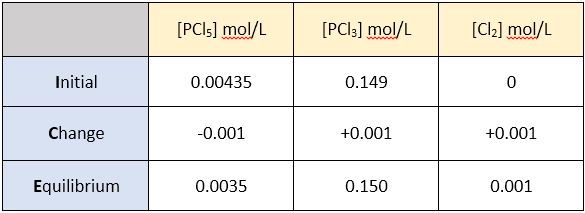
[PCl5]initial = 0.0087 mol / 2.0 L = 0.00435 mol / L
[PCl3]initial = 0.298 mol / 2.0 L = 0.149 mol / L
[Cl2]initial = 0 mol / L
[Cl2]equilibrium = 0.002 mol / 2.0 L = 0.001 mol / L
Step 2. Calculate the concentrations of each variable at equilibrium, using an ICE table
To calculate the concentrations of each variable at equilibrium we use a tool called an ICE table. ICE is an acronym for Initial, Change, Equilibrium and is set up as follows:
Initial row: we insert all our known initial concentrations

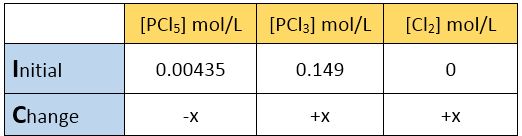
Change row: For the Change row, we insert the variable of the change that occurs from initial to equilibrium. From the reaction equation we see that the molar ratio of PCl5 : PCl3 : Cl2 is 1 : 1 : 1. Therefore for every increase in Cl2 of x mol/L there will be the same increase of x mol/L of PCl3 and a decrease of x mol/L of PCl5. For this example, we know that the concentration of Cl2 increased by 0.001 mol/L so this will be our value of x.
-
-
- For the Change in PCl5 and PCl3 we need to go back to the reaction equation and use their molar ratios to calculate the change. To do this we look at the value of the coefficients in front of each reactant and product. For the reaction: PCl5(g) ↔ PCl3(g) + Cl2(g), the molar ratio is 1 : 1 : 1, which tells us that for each mole of Cl2 formed, one mole of PCl3 is also formed and 1 mole of PCl5 is used up. Therefore if the change in Cl2 is + x, the change in PCl3 will also be +x and the change in PCl5 will be -x. In step 1 we just calculated that the change in [Cl2] was 0.001 mol/L therefore this is our x-value.
-
-
-
- If the molar ratio is not 1:1 for any variable, you simply multiply or divide the known value by that coefficient. For example if you have a reaction equation 2A ↔ B + C and you knew the change in C, you would simply multiply the value for the change in C by 2 to get your value for the change in A
-
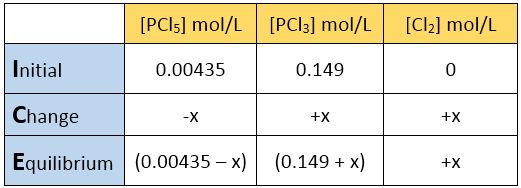
Equilibrium Row: calculate the concentration at equilibrium by adding the change to the initial concentration.
-
-
- [PCl5]equilibrium = 0.00435 mol / L - 0.001 mol/L = 0.00335 mol/L
- [PCl3]equilibrium = 0.149 mol / L + 0.001 mol/L = 0.150 mol/L
- [Cl2]equilibrium = 0.001 mol
-
Step 3. Calculate Keq
Keq= [PCl3][Cl2] / [PCl3] = (0.150 * 0.001) / 0.00335
Keq = 0.045
Check your understanding
A sealed 1.00 L flask was filled with 2.00 mol CO(g) and 2.00 mol H2O(g). They are allowed to react and form CO2(g) and H2(g). At equilibrium it is determined that 1.30 moles of each product are formed.
a) Write the balanced chemical equation
b) Write the equilibrium constant expression
c) Calculate the Keq.
Answer 4-2-A-1
D. Summary
- The equilibrium constant (Keq) describes a system at equilibrium based on the concentration of products and reactants at equilibrium.
- Keq = ([C]c[D]d) / ([A]a[B]b)
- Solids and pure liquids are not included in the equilibrium constant equation as their concentrations are constant.
- A large Keq means that the products are favoured (products have a higher concentration than the reactants) at equilibrium while a small Keq means the reactants are favoured at equilibrium.
- To calculate Keq from initial concentrations, an ICE table can be used.