SCH4U - Chemistry 12 (2024-25) - A
SCH4U-25A
4-2B: Common Equilibrium Constants
Description
In this activity you will learn about some of the many common equilibrium constants and how to use their values to understand different types of reactions.
Page content
A. Introduction
So far we have looked at the equilibrium constant (Keq) for a reversible chemical reaction. This value is dependent on the concentrations of all reactants and products at equilibrium. In chemistry there are also specific equilibrium constants for common reactions and circumstances which we will introduce in this lesson. All of the reactions we will examine below are reversible and the equilibrium constant only applies once these reactions have been allowed to proceed to equilibrium. One rule to remember when calculating equilibrium constants is that the concentration of a liquid or a solid is constant, so those values are not included in the formulae for equilibrium constants.
B. Kp: Equilibrium Constant using Pressures
For systems that are made up entirely of gases, each reactant and product contributes to the overall pressure of the system. The individual contribution of each reactant or product is called its partial pressure. To calculate the Kp for any system we use the same general formula that we used for Keq, using the coefficients in front of each reactant or product in the reaction equation as an exponent in the equilibrium constant equation we just simply substitute the partial gas pressures of each reactant and product for the concentration.
Example: For the following reaction, write the equation for the equilibrium constant Kp:
CH4(g) + Cl2(g) ↔ CH3Cl(g) + HCl(g)
Kp = (PCH3Cl * PHCl) / (PCH4 * PCl2)
Where P = the partial pressure of each
Click here to review Kp from the chemguide website.
C. Ksp: Solubility Product Constant
The Ksp is used for saturated solutions of ionic solids. In a saturated solution, there is a state of dynamic equilibrium occurring between the dissociated ions and the undissolved solid. For example, if you were to create a saturated solution of MgF2, your reaction equation would look like:
MgF2(s) ↔ Mg2+(aq) + 2F-(aq)
When we calculate the Ksp, we use the same general formula and units as in Keq, but we ignore the concentration of the solid because the concentration of any solid or liquid is constant. Therefore we only incorporate the concentration of the dissolved ions, therefore our equation for Ksp would be:
Ksp = ([Mg2+] * [F-]2)
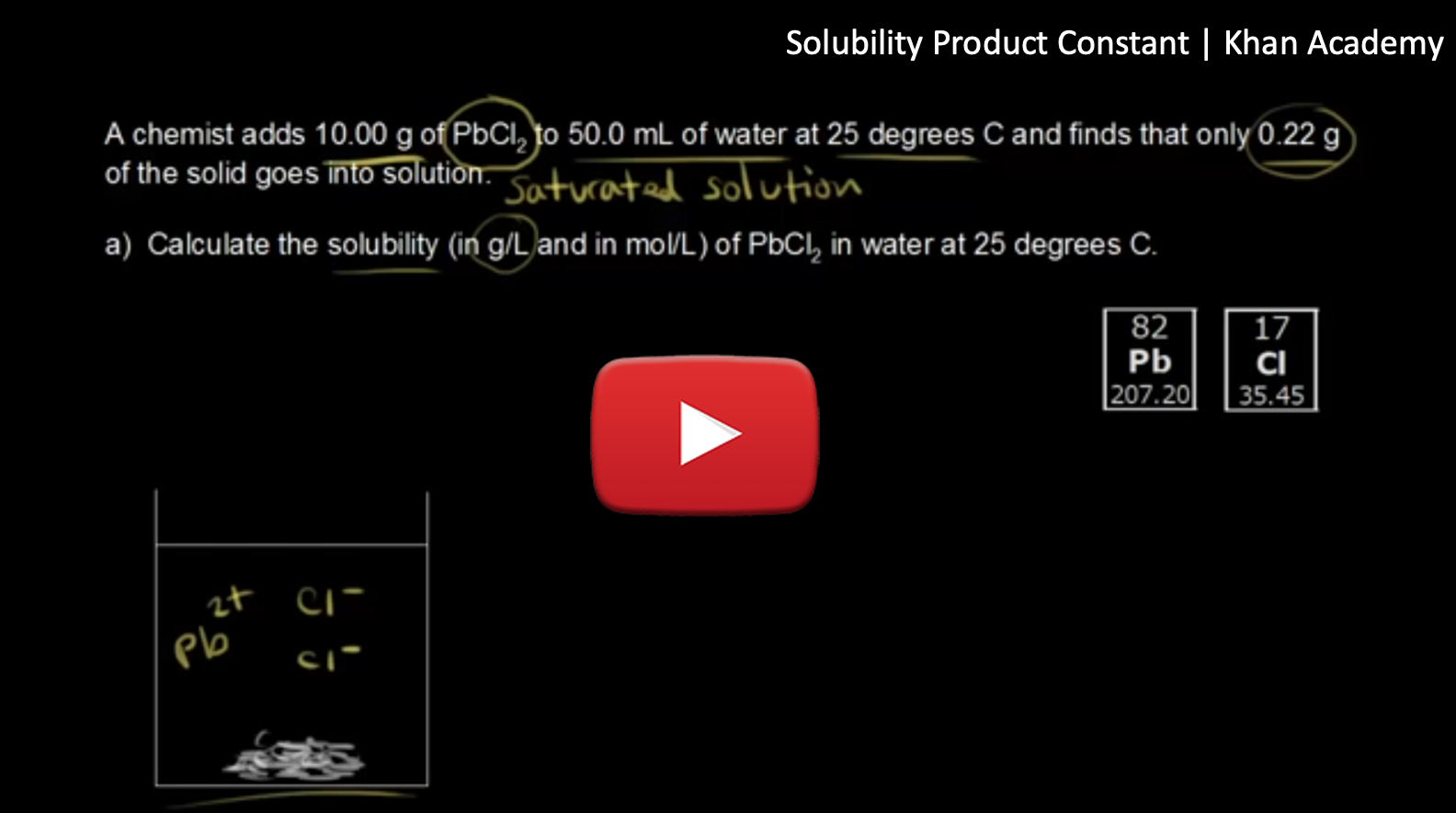
The following video from Khan Academy explores further how the solubility constant relates to solubility and how to apply these constants to solve solubility problems.
D. Ka: Acid Dissociation Constant
When an acid dissolves in water, a dynamic equilibrium forms between the forward reaction in which the acid dissociates into its individual ions and the reverse reaction in which the ions reconstitute. The Ka is the equilibrium constant that is specific to this ionization reaction. We can represent the ionization of a generic acid (HA) with the following reaction equation:
HA(aq) + H2O(l) ↔ H3O+(aq) + A-
As we said above for the Ksp, the concentration of a solid or liquid is constant, therefore when we calculate Ka, we ignore the liquid water in our equation and end up with:
Ka = ([H3O+] * [A-]) / [HA]
A strong acid ionizes almost completely, therefore the Ka is large and the equilibrium is shifted almost entirely towards the products.
For a weak acid, very little ionization occurs, therefore, Ka values are
very low and the equilibrium is shifted towards the reactants.
E. Kb: Base Ionization Constant
Similar to the Ka, the Kb is the equilibrium constant that is specific for the ionization of a base. The ionization of a base (B) can be represented by the reaction equation:
B(aq) + H2O(l) ↔ BH+(aq) + OH-(aq)
As we did with Ka, we do not include the concentration of liquid water in our equation for Kb, therefore our equation for Kb is:
Kb = ([BH+] * [OH-]) / [B]
A strong base ionizes almost completely, therefore the Kb is large and the equilibrium is shifted almost entirely towards the products. For a weak base, very little ionization occurs, therefore, Kb values are very low and the equilibrium is shifted towards the reactants.
F. Summary
- Certain common reactions have specific equilibrium constants associated with them
- Kp is the equilibrium constant used for reactions involving only gases at constant pressure
- When calculating Kp, we use the partial pressures of each gas to instead of concentrations when plugging values into the equilibrium constant expression
- Ksp = solubility product constant, used for the equilibrium of a saturated ionic solution where an equilibrium forms between the solid and dissolved ions
- Ka = acid dissociation constant, used for the equilibrium that forms when a weak acid dissolves in water
- Kb = base dissociation constant, used for the equilibrium that forms when a weak base dissolves in water