SCH4U - Chemistry 12 (2024-25) - A
SCH4U-25A
5-1A: Electrochemistry Introduction
Description
In this activity you will be introduced to electrochemistry, redox reactions and half-reactions.
Page content
A. Electrochemistry Introduction
 |
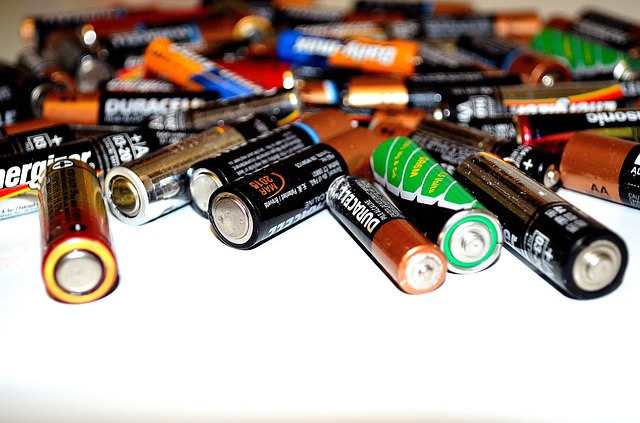 |
Electrochemistry is a branch of chemistry that we can observe all around us. When you see a piece of metal rusting or when you use a battery powered device, you are observing an electrochemical reaction in action. Electrochemistry is a type of chemical reaction in which electrons are transferred between reactant species.
In this unit we will be exploring these reactions in which electrons are transferred between reactants, which are known as OXIDATION-REDUCTION reactions. Oxidation-Reduction reactions are commonly abbreviated to REDOX REACTIONS, which we will use throughout this unit. Many common reactions that you have been introduced to are examples of redox reactions, these include:
Combustion Reactions:
In a combustion reaction, a compound is burned in the presence of oxygen producing carbon dioxide and water.
C3H8 + O2 --> CO2 + H2O
Single Displacement Reactions:
In a single displacement reaction, two elements swap places within a compound. For example in the following reaction, Mg and Cu on the reactant side of the equation swap places to produce Cu and MgSO4
Mg(s) + CuSO4(aq) → Cu(s) + MgSO4(aq)
Now lets begin by exploring some of the fundamentals of these redox reactions.
B. Oxidation and Reduction Terminology:
As we said above, redox reactions involve the transfer of electrons between reactant species. In any electron transfer, one species loses electrons while another species gains electrons. When we say species here this could mean an atom, molecule or ion.
Oxidation
The loss of electrons in a reaction is known as OXIDATION. In a redox reaction, the species that loses electrons is known as the reducing agent. So, for a redox reaction, we would say that a reducing agent loses electrons, becoming oxidized.
Reduction
The gaining of electrons in a redox reaction is known as REDUCTION. In a redox the species that gains electrons is known as the oxidizing agent. So for a redox reaction we would say that an oxidizing agent gains electrons, becoming reduced.
The following acronyms are good memory tools to remember the difference between oxidation and reduction:
LEO = Lose Electrons is Oxidation
GER = Gain Electrons is Reduction
Lets look at an example to apply these terms:
If a piece of magnesium is placed in an aqueous solution of copper (II) sulfate, the following reaction will occur:
Mg(s) + CuSO4(aq) → Cu(s) + MgSO4(aq)
In reality, the CuSO4 and the MgSO4 in solution will dissociate into its individual ions (Cu2+, Mg2+and SO42-), so lets rewrite the equation to reflect the dissociation:
Mg(s) + Cu2+(aq) + SO42-(aq) → Cu(s) + Mg2+(aq) + SO42-(aq)
Notice in the above equation, that SO42- appears on both sides of the reaction in the same form, we call this a SPECTATOR ION and we can remove it from the equation:
Mg(s) + Cu2+(aq) + SO42-(aq) → Cu(s) + Mg2+(aq) + SO42-(aq)
to give us the NET IONIC EQUATION for the reaction:
Mg(s) + Cu2+(aq) + → Cu(s) + Mg2+(aq)
Looking at the net ionic equation above, we can see that by the charges on each, that the Mg atom loses 2 electrons to form the ion Mg2+ and the Cu2+ ion gains to electrons to form the Cu atom:
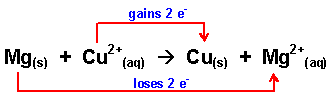
Therefore, applying our terminology for redox reactions for the reaction above, the Mg atom is OXIDIZED because it loses electrons while the Cu2+ ion is REDUCED because it gains electrons. Furthermore, the Mg atom is the reducing agent and the Cu2+ ion is the oxidizing agent.
C. Half-Reaction Equations
We have learned that in a redox reaction electrons are transferred, with one species losing electrons and becoming oxidized while another species gains electrons, becoming reduced. A half reaction equation is one that takes the full redox reaction equation and splitting it in to two half reactions, each half representing either the oxidation or reduction reaction.
For example lets use our equation above and split it into half reactions. We already established that we can remove any spectator ions from a redox reaction equation so we are left with:
Mg(s) + Cu2+(aq) + → Cu(s) + Mg2+(aq)
Oxidation half-reaction:
In the oxidation half reaction, we have magnesium (Mg), losing 2 electrons (e-), forming a Mg2+ ion:
Mg(s) + → Mg2+(aq) + 2e-
In this half reaction, the Mg has been oxidized because it lost electrons.
Reduction half-reaction:
In the reduction half-reaction, we have a copper ion (Cu2+) gaining 2 electrons:
Cu2+(aq) + 2e- → Cu(s)
In this half reaction the Cu2+ has been reduced because it gained electrons.
Sample Problem:
Write the oxidation and reduction half-reactions from the net redox reaction equation. Identify which half reaction is oxidation and which is reduction. For the following reaction:
Cu2+(aq) + Zn(s) → Zn2+(aq) + Cu(s)
Step 1. Separate the reaction into 2 half-reactions:
Cu2+(aq) → Cu(s)
Zn(s) → Zn2+(aq)
Step 2. Add electrons to both equations so that the net charge on each side of the equation is equal
Cu2+(aq) + 2e- → Cu(s)
Step 3. Identify which half-reaction represents an oxidation reaction and which represents a reduction reaction:
Oxidation (loses electrons): Zn(s) → Zn2+(aq) + 2e-
Reduction(gains electrons): Cu2+(aq) + 2e- → Cu(s)
Check your understanding:
Write the oxidation and reduction half-reactions from the net redox reaction equation. Identify which half reaction is oxidation and which is reduction. For the following reaction:
Sn2+(aq) + Co(s) → Sn(s) + Co2+(aq)
For a detailed introduction to Redox reactions and electrochemistry watch the following video from Khan Academy
Source: https://www.khanacademy.org/science/chemistry/oxidation-reduction/redox-oxidation-reduction/v/oxidation-reduction-or-redox-reactions
D. Summary
- Electrochemistry involves chemical reactions in which electrons are transferred between reactant molecules
- Reactions involving electron transfer are either oxidation or reduction reactions. We use the abbreviation redox to describe these reactions
- Oxidation is a reaction in which electrons are lost by the reactant species
- The species that loses electrons is known as the reducing agent
- Reduction is a reaction in which electrons are gained by the reactant species
- The species that gains electrons is known as the oxidizing agent
- Spectator ions are those that appear as both a reactant and a product, they can be removed from the net ionic equation
- In a redox reaction, we can identify which species are reduced and oxidized by comparing their charges on either side of the reaction arrow
- Half-reaction equations take the net ionic equation for a redox reaction and split them into oxidation half-reactions and reduction-half reactions