SCH4U - Chemistry 12 (2024-25) - A
SCH4U-25A
5-3B: Spontaneity of Redox Reactions
Description
In this activity you will learn how to use standard reduction potentials to predict the spontaneity of redox reactions.
Page content
A. Electrical Potential
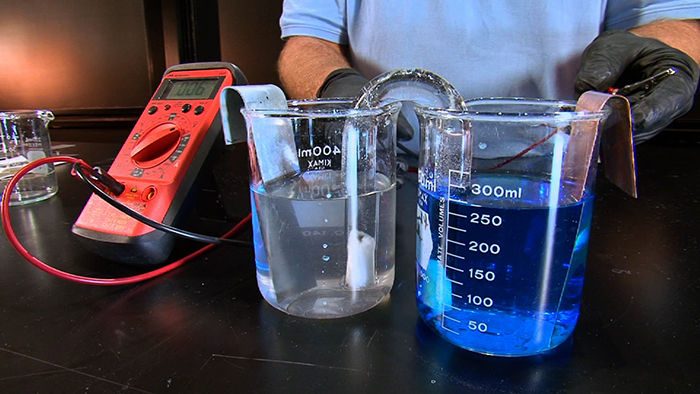
The electrical potential of a galvanic cell is a measure of its ability to produce an electric current and is typically measured in units of volts (V). When two half-cells are connected, the half-cell that has a greater tendency to acquire electrons will be the half-cell in which reduction occurs, while the half-cell with a lesser tendency to acquire electrons will be the one in which oxidation occurs. The tendency of a half-cell to undergo the reduction reaction is called its REDUCTION POTENTIAL. When two-half cells are linked, the one that has the greater reduction potential will undergo reduction while the other one will undergo oxidation. The difference between the two reduction potentials is called the CELL POTENTIAL (E0cell) given in units of volts (V) and is calculated by the following formula:
E0cell = E0red + E0oxid
Where: E0red is the reduction potential of the half-cell undergoing reduction and E0oxid is the reduction potential for the half-cell undergoing oxidation. The standard conditions for measuring cell potential is when the concentration of the solutions are 1M and the temperature is 25 ºC.
B. Standard Reduction Potentials
© Science Media Group. Source
The reduction potential for a given half-cell cannot be measured on its own, it needs to be part of a complete cell to be measured. Because of this, chemists devised a standard half-cell to use as a reference to measure all other half-cells with. The reference half-cell used is the hydrogen half-cell, which is a half-cell in which the following reversible reaction occurs:
2H+(aq) + 2e- ↔ H2(g)
Because the reaction above is reversible it can occur as a reduction (forward) or an oxidation (reverse). Whether the reaction occurs as a reduction or oxidation depends on the other half-cell that hydrogen half-cell is attached to. The standard cell potential of the hydrogen half-cell (E0H+) has been given an aribtrary value of 0.00.
To determine the standard reduction potential of any other half-cell, chemists set up a galvanic cell that in which one half-cell is the hydrogen half-cell, which has a known standard reduction potential of 0.00 V and the other half-cell is made up of a half-cell with an unknown standard reduction potential, such as a zinc half cell. The full cell potential (E0cell) can then be measured using a voltmeter and we can then deduce the standard reduction potential for the unknown half-cell. For example, when the zinc half-cell is connected to the hydrogen half cell, that standard reduction potential for the zinc half-cell is measured at -0.76 V. This negative value means that the zinc half-cell underwent oxidation when connected to the hydrogen half-cell. On the other hand, some half-cells have positive standard reduction potentials which means that the half-cell undergoes reduction when connected to the hydrogen half-cell.
Chemists have measured the standard reduction potentials for many common half-reactions which can be found in a table of standard reduction potentials. The greater the standard reduction potential for a half-reaction, the more likely it is to undergo a reduction reaction. If you are constructing a galvanic cell, the half-cell that has the greater standard reduction potential will be the half-cell that undergoes the reduction reaction, while the other half-cell will undergo an oxidation reaction.
C. Predicting Spontaneity of Redox Reactions
A galvanic cell is made up of 2 half-cells, one undergoing an oxidation reaction and the other undergoing a reduction reaction. The half-cell that has the greater standard reduction potential will be the one that is reduced while the other will be oxidized. We can also use standard reduction potential values to predict whether a redox reaction will occur spontaneously or not. For a redox reaction to occur spontaneously, the cell potential (E0cell) must be positive. If the cell potential is negative, the reaction will be spontaneous in the opposite direction. Lets look at an example:
Predict whether the following redox reaction will occur spontaneously:
Zn(s) + 2Ag+(aq) → Zn2+(aq) + 2Ag(s)
Step 1. Identify which half-reaction is undergoing oxidation and which is undergoing reduction
The oxidation number of Zn changes from 0 to +2 therefore it is oxidized
The oxidation number of Ag changes from +1 to 0 therefore it is reduced
Oxidation reaction: Zn(s) → Zn2+(aq) + 2e-
Reduction reaction: Ag+(aq) + e-→ Ag(s)
Step 2. Look up the standard reduction potentials for each half-cell
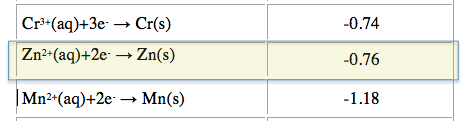
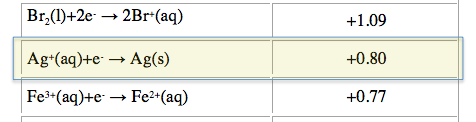
**Notice that this is a standard table of reduction potential. Zinc is oxidized: Zn(s) → Zn2+(aq) + 2e-Therefore, the oxidation potential of zinc (Zn) would be the reverse of the reduction reaction so: -(-0.76V) = + 0.76V. This is similar to what you learned about using standard enthalpy of formation values for application of Hess's Law.
Step 3. Plug the standard reduction potential values into the equation for cell potential:
E0cell = E0red + E0oxid
E0cell = (+0.80 V) + (+0.76 V)
E0cell = +1.56 V
Step 4. Solution
Since E0cell = is positive the reaction as written is spontaneous. If the E0cell value were negative we would say that the reverse reaction is negative.
Check your understanding:
Try this practice question:
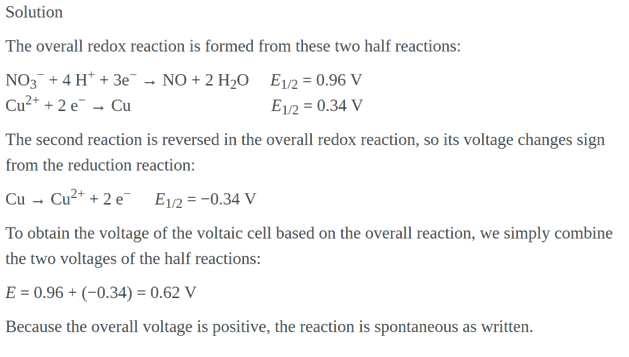
What is the voltage of a voltaic cell based on this reaction? Is the reaction spontaneous as written?
2 NO3− + 8 H+ + 3 Cu → 2 NO + 4 H2O + 3 Cu2+
Test Yourself:
What is the voltage of a voltaic cell based on this reaction? Is the reaction spontaneous as written?
5 Ni + 2 MnO4− + 16 H+ → 2 Mn2+ + 8 H2O + 5 Ni2+
Answer
1.76 V; spontaneous
Review
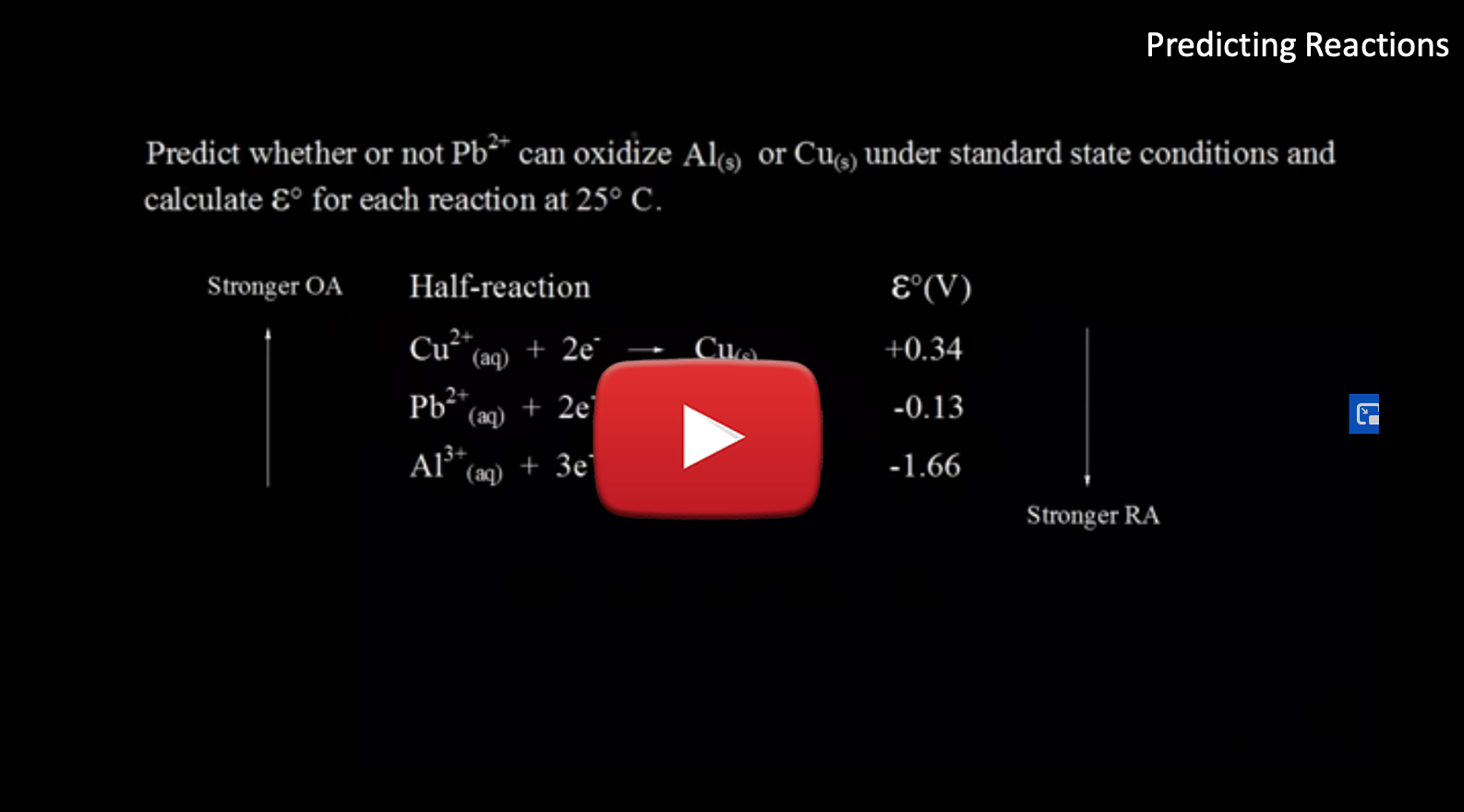
The following video how to use information about the electrodes in a galvanic cell to predict the spontaneity of the redox reaction.
Source: https://www.khanacademy.org/
D. Summary
- The electrical potential of a galvanic cell is a measure of its ability to produce an electric current. Measured in units of volts (V)
- In a galvanic cell, the half-cell that has a greater tendency to acquire electrons will be the one where reduction occurs
- The tendency of a half-cell to undergo the reduction reaction is called its reduction potential
- The difference between the two reduction potentials is called the cell potential (E0cell)
- E0cell = E0red + E0oxid
- A redox reaction will occur spontaneously if E0cell is positive
- The hydrogen half-cell is used as the reference cell to measure all other standard reduction potentials