SCH4U - Chemistry 12 (2024-25) - A
SCH4U-25A
5-3C: Summary
This page is part of the content downloaded from 5-3C: Summary on Monday, 3 March 2025, 9:20 AM. Note that some content and any files larger than 50 MB are not downloaded.
Description
5-3C: Summary
Page content
Summary
- The goal of a galvanic cell is to produce electricity through the movement of electrons.
- A galvanic cell is made up of 2 half-cells, in one half-cell, a reduction reaction takes place while in the other half-cell an oxidation reaction takes place.
- The two half-cells of a galvanic cell are connected externally by a metal wire through which electrons move, this external wire is often connected to a voltmeter or a component that requires electricity.
- The two half-cells are connected internally by a salt bridge that functions to maintain electrical neutrality in each half cell. The salt bridge is made up of a tube that is filled with an electrolyte solution such as KNO3 or KCl.
- Each half-cell is composed of a strip of metal (the electrode) immersed in a salt solution that contains ions made up of the same element as the metal strip.
- The half-cell where reduction takes place is called the cathode.
- The half-cell where oxidation takes place is called the anode.
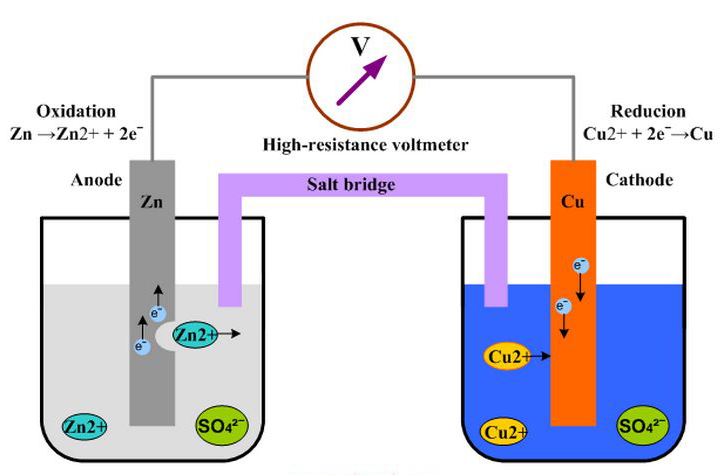
- The electrical potential of a galvanic cell is a measure of its ability to produce an electric current. Measured in units of volts (V).
- In a galvanic cell, the half-cell that has a greater tendency to acquire electrons will be the one where reduction occurs.
- The tendency of a half-cell to undergo the reduction reaction is called its reduction potential.
- The difference between the two reduction potentials is called the cell potential (E0cell).
- E0cell = E0red - E0oxid
- A redox reaction will occur spontaneously if E0cell is positive.
- The hydrogen half-cell is used as the reference cell to measure all other standard reduction potentials.