SCH4U - Chemistry 12 (2024-25) - A
SCH4U-25A
Review: Balancing Chemical Equations
Description
In this activity you will review a technique to balance chemical equations to make sure that they follow the law of conservation of mass.
Page content
Balancing Chemical Equations
The following presentation explores techniques for balancing chemical equations. When balancing redox reactions you must first follow the steps outlined in the learning activities in the rest of the lesson.
When there are unequal numbers of atoms of elements between the products and reactants, the equation is “unbalanced”. For example, an unbalanced reaction between hydrogen and nitrogen gas to produce ammonia could look like this:
N2 + H2 --> NH3
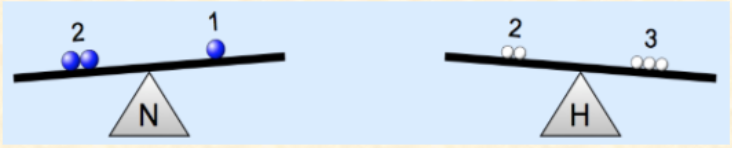
On the reactants side, there are 2 N and 2 H. However on the products side, there is 1 N and 3 H. Therefore the equation is unbalanced.
A balanced chemical equation will have the same total number of atoms of each element in the reactants as in the products.
Unbalanced: N2 + H2 --> NH3

When a reaction has been successfully balanced, there will be an equal number of each type of atom in the reactants and products.
Balanced: N2 + 3H2 --> 2NH3

Balancing chemical equations is a process involving adjusting the coefficients in front of different molecules and atoms. It often takes going back and forth, adjusting the coefficients until a fully balanced equation is achieved.
The step-by-step process is as follows:
1. For each element, count the number of atoms on each side of the arrow.
2. Identify any unbalanced elements.
3. Multiply the chemical formulas by appropriate coefficients. Keep checking and adjusting the coefficients until all of the elements are balanced. This may take some trial and error. Note: You cannot adjust the subscripts.
4. Check to make sure the equation is balanced.
5. Write the final chemical equation.
Balance the following equation: N2 + H2 --> NH3
1. For each element, count the number of atoms on each side of the arrow.
Reactants: • 2 N • 2 H
Products: • 1 N • 3 H
2. Identify any unbalanced elements. Both the N and the H are unbalanced as there are unequal numbers of both on either side of the arrow.
3. Multiply the chemical formulas by appropriate coefficients. Keep checking and adjusting the coefficients until all of the elements are balanced. This may take some trial and error. Since we have 2 N on the left, we need 2 N on the right. If we add the coefficient 2 in front of NH3, this will give us 2 N on the product side.
N2 + H2 --> 2NH3
Reactants: • 2 N • 2 H
Products: • 2 N (2 x 1 = 2) • 6 H (2 x 3 = 6)
The nitrogen atoms (N) are now balanced. However, the equation is still not balanced, because the hydrogen (H) atoms are unbalanced. Therefore, we must adjust the coefficients again. By multiplying the number of H2 molecules on the left by 3 this will balance out the H atoms.
N2 + 3H2 --> 2NH3
Reactants: • 2 N • 6 H (3 x 2 = 6)
Products: • 2 N • 6 H
There are equal numbers of nitrogen atoms and hydrogen atoms on each side of the equation. Therefore, the balanced chemical equation for the production of ammonia from hydrogen and nitrogen is:
N2 + 3H2 --> 2NH3
Test your understanding.
Balance the following equation which shows the combustion of methane gas. CH4 + O2 --> CO2 + H2O
Reactants: • 1 C • 4 H • 2 O
Products: • 1 C • 2 H • 3 O
There are 4 H on the left and 2 H on the right. Therefore if a coefficient of 2 is added to the H2O molecule, the H is balanced.
CH4 + O2 --> CO2 + 2H2O
Reactants: • 1 C • 4 H • 2 O
Products: • 1 C • 4 H • 4 O
The C and H are now balanced, but the O is unbalanced. If a coefficient of 2 is added to the O2 molecule on the left, the O will balance out
CH4 + 2O2 --> CO2 + 2H2O
Reactants: • 1 C • 4 H • 4 O
Products: • 1 C • 4 H • 4 O
Therefore, the balanced equation for the combustion of methane is: CH4 + 2O2 --> CO2 + 2H2O