| Introduction to Citations
|
|
.
|
In all your courses you will be required to use outside sources in research projects and assignments. In such situations, you would include the words or ideas of other people into your own work. When you do so, you must give credit for the original source of information or the idea. In other words, you must "cite" the source. When you do not properly cite or credit the original source in your work, it comes across as cheating or as a plagiarized work. Your teacher would then give a zero for your assignments!
This citation guide will explain everything you need to know to safely and correctly cite your sources.
|
|

|
|
First, you will learn the 3 methods of using outside sources: Direct Quoting, Paraphrasing, & Summarizing. Then, you will focus on formatting citations using a widely used style called "APA style". Finally, you will put all parts of citing together to understand how and when to use citations.
|
.
|
| Methods of Using Outside Sources
|
|
You must use and integrate outside sources in a fair and attentive manner. By doing so, you help to demonstrate that you have carefully read and considered the material on your topic. Your teacher and classmates see not only your ideas alone, but also your points contextualized by the ideas of others.
There are 3 methods of using outside sources: Direct Quoting, Paraphrasing, & Summarizing
|
What is it?
|
When to use it?
|
How to Cite it?
|
| Direct Quotations |
are words and phrases that are taken directly from another source and then used word-for-word in your paper. You must put that quotation or phrase in quotation marks. |
sparingly and when the original language has a strong impact; with set-up, context, and proper citation;
followed by commentary, analysis, or explanation.
|
as in-text citation with a corresponding entry in the References page. |
| Paraphrasing |
expressing the meaning of the original source using different words.
|
to contextualize the information (who said it, when, and where) ; to restate all the supporting points to develop the main idea of the original text;
to share important information from the source while maintaining their own voice.
|
as in-text citation with a corresponding entry in the References page. |
| Summarizing |
involves condensing the main idea of a source into a much shorter overview. A summary outlines a source’s most important points and general position. |
to contextualize the information (who said it, when, and where); by condensing the source to its main ideas and without using quotations or citing specific supporting points of the passage;
to support their claims.
|
as in-text citation with a corresponding entry in the References page. |
|
| Formatting Citations - APA Style
|
|
We use a standard format to cite. Major formats come from organizations like the American Psychological Association (APA) or the Modern Language Association (MLA). You will be using APA style in all your courses.
Regardless of the style, when you cite, you do two things
|
| In-Text Citation - APA Style
|
|
-
The in-text citation usually appears in parentheses and corresponds directly to an entry in your list of References.
-
The author's last name and the year of publication are usually enough to indicate the location in the source. For sources with numbered pages, include the page number as well.
-
If the author's name is used in the sentence, do not repeat it in the citation.
Here is the standard correct in-text citation style according to APA guidelines:
“Quotation” (Author's Last Name, Year of Publication).
OR
"Quotation" (Author’s Last Name, Year of Publication, Page Number).
Take a moment to carefully consider the placement of the parts and punctuation of this in-text citation. Note that there is no punctuation indicating the end of a sentence inside of the quotation marks—closing punctuation should instead follow the parentheses. There is a comma between the author’s last name and the date of publication inside of the parentheses. If a page number is included, there is another comma between the date of publication and the page number. The misplacement of these simple punctuation marks is one of the most common errors students make when crafting in-text citations.
Usually the author and year of publication are enough for in-text citations, but there are common exceptions. Take a look at common exceptions and examples here.
|
| Works Cited Section - APA Style
|
|
-
Page numbers: Just as the rest of your paper, the top of the page should retain the right-justified header with the page number.
-
Title: On the first line, the title of the page— "References”—should appear centered and not italicized, bolded, or placed in quotation marks.
-
Alphabetical order: Starting on the next line after the page title, your references should be listed in alphabetical order by author.
-
Spacing: Like the rest of your paper, this page should be double-spaced and have 1-inch margins (don’t skip an extra line between citations).
-
Hanging indents: Each reference should be formatted with what is called a hanging indent. This means the first line of each reference should be flush with the left margin (i.e., not indented), but the rest of that reference should be indented 0.5 inches further. Any word-processing program will let you format this automatically. (In Microsoft Word, for example, you simply highlight your citations, right-click and choose “Paragraph”, and choose “hanging indent” under the “Special” section.)
Here is an example of formatted References Section:
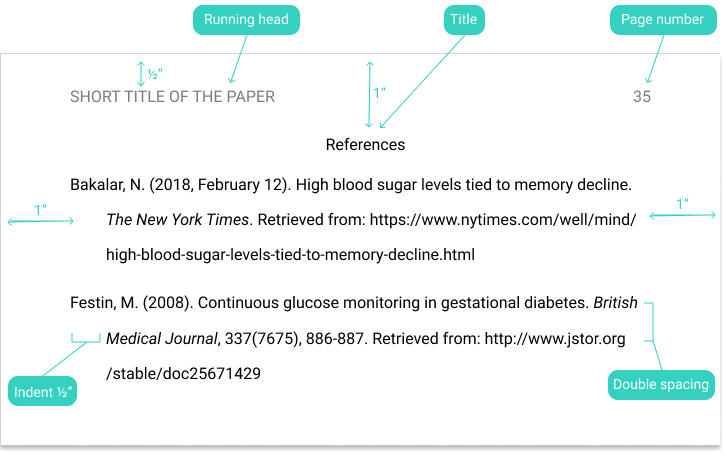
Source: APA Reference Page - Scribbr
There is a specific Reference List format for each type of source. Take a look at the format and examples here.
Here are some helpful websites that will generate the citations for your References List. Make sure to double-check that the citations include the correct information and follow the appropriate format:
-
Citation Machine
-
Bibme
- Cite This For Me
|
|
Let's Put it All Together
|
|
Use the following flow-chart to determine when to use APA citation:
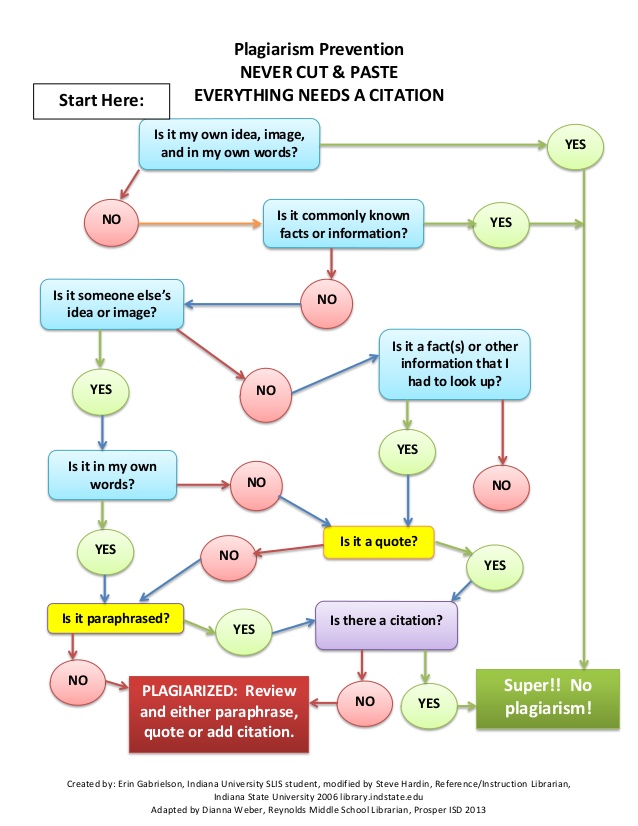
Source: Plagiarism and citing flow chart - Prosper High School
|